Insights · Approvals
FEB vs FER: what's the difference, and who approves them in WA?
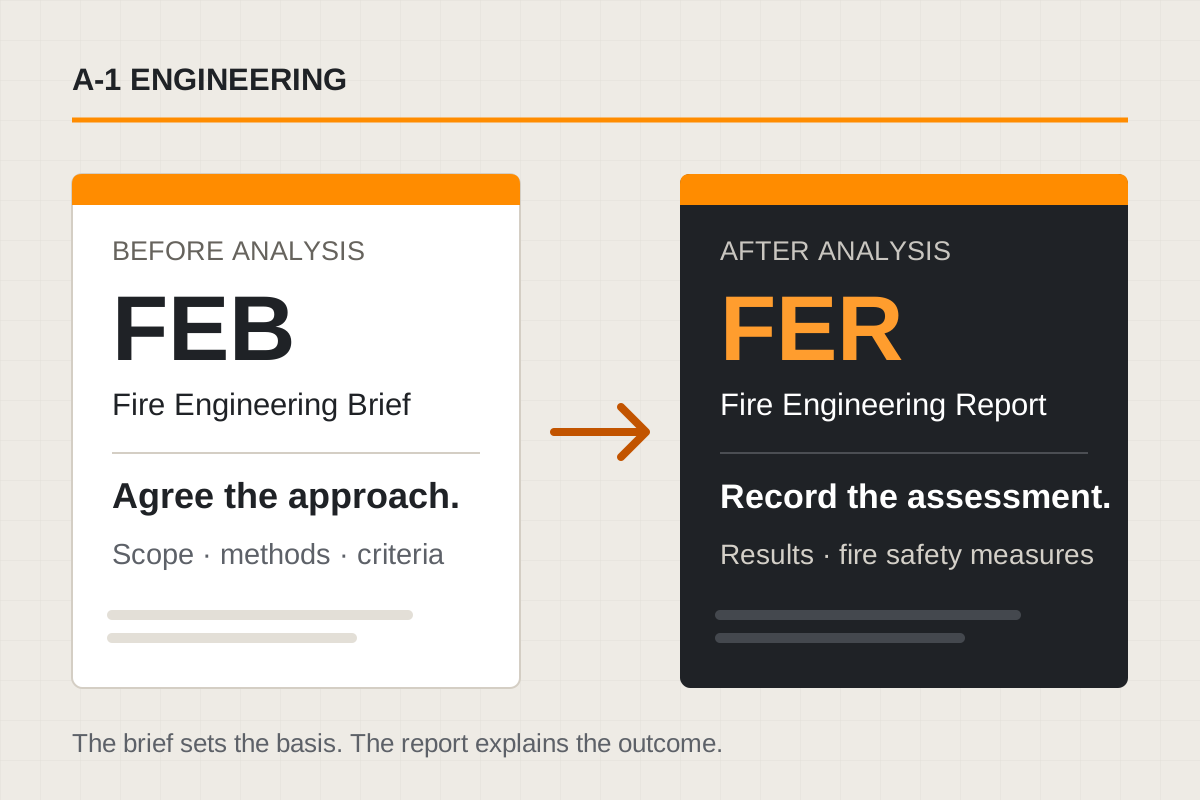
The brief sets out what will be assessed. The report records the assessment, results and fire safety measures.
Side by side
| At a glance | Fire Engineering Brief (FEB) | Fire Engineering Report (FER) |
|---|---|---|
| Timing | Before analysis | After analysis |
| Purpose | Agree the scope, methods and acceptance criteria | Show compliance and document the strategy |
| Key content | Departures, Performance Requirements, scenarios, methods, criteria | Analysis, results, required fire safety measures, management requirements |
| Main audience | Stakeholders and DFES | Building surveyor, design team, DFES and the owner |
The Fire Engineering Brief
The project fire engineer prepares the FEB with the relevant stakeholders before analysis begins. It sets out the questions to assess and how the design will be checked. A brief commonly records:
- The building, its use, its occupants and the relevant NCC edition
- Each departure from the Deemed-to-Satisfy provisions, and the Performance Requirements it relates to
- The assessment methods (for example comparative or absolute analysis, CFD or evacuation modelling)
- The fire scenarios, design fires and inputs
- The acceptance criteria that will show success
- The stakeholders and how their comments will be resolved
Its purpose is to establish the basis for analysis. Consulting the building surveyor, owner and other relevant stakeholders early helps identify concerns before detailed work begins. For projects involving DFES, follow its current advice and submission process.
The Fire Engineering Report
The FER records the fire engineer’s assessment of the proposed design. It explains the calculations or modelling, the results, and how the design meets the relevant fire safety requirements. It also sets out the fire safety measures and management requirements the design team and owner need to follow.
The building surveyor considers the FER as part of the building approval process. For the owner, it can record the fire safety strategy and the measures on which the Performance Solution relies.
How they move through approval
The fire engineer develops the brief in consultation with relevant stakeholders. DFES publishes current guidance and documentation for fire safety Performance Solutions; the applicable consultation and submission steps depend on the project. Check the DFES regulation and compliance guidance for current requirements.
DFES encourages early consultation so project-specific requirements can be considered while the design and submission scope are being developed.
Avoiding delays
- Freeze the inputs. Confirm the NCC edition, building classification and design basis before the FEB is issued.
- Reconcile departures. Use the building surveyor's BCA report as an input, and confirm the design details and any changes with relevant project stakeholders.
- Name every stakeholder early. That includes the owner's insurer and the facility manager where relevant.
- Track design changes. If the architecture changes after the FEB is agreed, check whether the basis still holds before the analysis carries on.